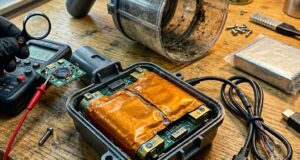
When shopping for the best portable car vacuum, most buyers focus heavily on raw suction power (measured in Pascals or Air Watts), attachment versatility, and initial runtimes. However, there is a silent, chemical clock ticking inside these handheld devices: Battery Life Degradation.
Over time, a portable vacuum that once ran for a solid 30 minutes on a single charge might struggle to clear a single floor mat before dying. As battery chemistry evolved to pack more power into smaller form factors, it introduced a fresh set of challenges.
1. Extreme Cabin Microclimates (Thermal Stress)
Car vacuums are uniquely exposed to some of the harshest environments of any household appliance because they are often stored directly in the vehicle.
- The Greenhouse Effect: In summer, internal car temperatures can easily surpass 60°C (140°F). Conversely, winter can drop temperatures well below freezing.
- Chemical Acceleration: High heat accelerates the parasitic chemical reactions inside Lithium-Ion (Li-ion) cells, permanently lowering their energy capacity even when the vacuum is not in use.
- The Cold Start Challenge: Attempting to run or charge a freezing cold battery forces the lithium ions to “plate” onto the anode, which can cause permanent short circuits and drastic capacity loss.
2. The “Max Suction” Mode Trap
To rank as a best portable car vacuum, manufacturers often include a “Turbo” or “Max” mode to pull deeply embedded dirt out of heavy car carpets.
- High Current Draw: Max modes demand massive current (high C-rate discharge) from small battery packs.
- Internal Resistance Spikes: Drawing maximum current causes rapid internal heating due to Joule heating ($P = I^2 R$). This thermal spike degrades the separator membrane inside the battery.
- The 5-Minute Lifespan: Continuous use of turbo modes can reduce a battery’s overall lifecycle from 500 charge cycles down to fewer than 150.
3. Deep Discharge Cycles (The “Run It Till It Dies” Habit)
Unlike smartphones, which users rarely let drain completely to 0%, car vacuums are typically operated until they completely cut out.
- Voltage Drops: Running a vacuum until it completely shuts off pushes the battery cells into their lower voltage limits.
- Anode Dissolution: Repeatedly hitting absolute zero state-of-charge (SoC) causes the copper current collectors in the battery to dissolve into the electrolyte, creating permanent internal damage.
- Incomplete Cleaning Cycles: Because car detailing is highly active, users tend to stretch the battery to its absolute limit to finish “just one more seat,” exacerbating this issue.
4. Fast-Charging Compromises
Modern users expect rapid turnaround times. If a vacuum runs out of juice mid-clean, waiting 4 hours to recharge is frustrating. Consequently, newer models feature fast USB-C Power Delivery (PD) charging.
- Heat Generation During Charge: Fast charging forces lithium ions into the anode at high speeds. This process generates substantial heat, which is trapped inside the tight, sealed plastic casing of a compact vacuum.
- Lack of Active Cooling: Unlike electric vehicles or high-end laptops, small handheld vacuums do not have active fan cooling for their battery packs during charging, leading to heat-soak degradation.
5. Built-in, Non-Replaceable Battery Designs
One of the biggest design-related challenges is the planned obsolescence driven by integrated battery packs.
- E-Waste Creation: When the battery degrades to a 5-minute runtime, the entire vacuum—including the perfectly functional motor and plastic housing—is often thrown away because the battery is soldered inside.
- Lack of Modular Options: Very few brands offer click-in, swappable battery packs for portable car vacuums, making professional repairs economically unfeasible for consumers.
6. Battery Management System (BMS) Calibration Drift
A Battery Management System (BMS) controls the safety, charging, and discharging of the cells. However, vacuum BMS chips face unique calibration hurdles.
- Erratic Usage Patterns: Car vacuums sit idle for weeks, followed by sudden, intense bursts of high-drain usage.
- State-of-Charge Confusion: This erratic cycle confuses the BMS’s ability to calculate the true capacity of the cells. The vacuum may report “low battery” and shut down prematurely, even if the chemical cells still hold a charge.
7. High Vibration and Mechanical Stress
Cleaning a car is a physical process. Vacuums are dropped, banged against seats, and subjected to engine vibrations while stored in trunks.
- Physical Micro-Fractures: Constant physical impacts can cause micro-fractures in the internal tabs connecting the battery cells.
- Increased Internal Resistance: Even if the cells are chemically healthy, damaged physical connections increase electrical resistance, causing the battery to overheat faster and perform poorly.
[Frequent Deep Discharge] ──┐
[Extreme Cabin Storage]    ├──> [Rapid Heat Buildup] ──> [Permanent Capacity Loss]
[Continuous Turbo Mode]    ──┘
Strategic Tips: How to Prevent Battery Degradation
To ensure your investment remains the best portable car vacuum in your cleaning arsenal for years to come, follow these maintenance best practices:
- Never Store it in the Trunk: Bring your vacuum indoors. Storing it in a climate-controlled room instead of a hot trunk can double its lifespan.
- Avoid “Max” Mode Overuse: Use the standard suction setting for dusty dashboards and hard surfaces. Reserve the Turbo boost strictly for stubborn carpet debris.
- Charge at 20%, Stop at 80%: If possible, do not wait until the motor completely stalls before plugging it in. Charging it slightly before it fully drains keeps the voltage levels stable.
- Let it Cool Before Charging: Never plug the vacuum into a charger immediately after a heavy cleaning session. Let the internal cells cool down for 15 to 20 minutes first.
The evolution of the best portable car vacuum has brought incredible suction power and cordless freedom, but it has placed an immense burden on battery tech. By understanding these new thermal, chemical, and physical challenges, consumers can adapt their usage and storage habits to keep their handheld vacuums running at peak performance for years to come.