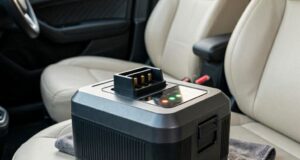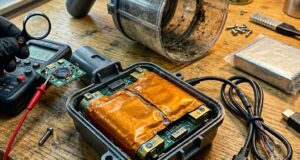
When car owners search for the best portable car vacuum, they often look for maximum motor power to pull deeply embedded dirt, sand, and pet hair out of their vehicle’s carpets. While cordless models are popular, many detailers prefer corded $12\text{V}$ vacuums because they offer unlimited runtime by plugging directly into the vehicle’s cigarette lighter socket (auxiliary power outlet).
However, this direct connection introduces a highly frustrating electrical hazard: 12V cigarette lighter fuse blowouts.
Modern vehicles are packed with delicate computers, meaning car manufacturers strictly limit the electrical current flowing through auxiliary outlets. When a high-draw, heavy-duty $12\text{V}$ vacuum tries to pull more juice than the circuit can handle, the fuse sacrifices itself to protect your car’s wiring.
1. The Startup Inrush Current Spike (The “Instant Blow” Challenge)
The moment you click the power switch on a high-suction corded vacuum, a quiet electrical phenomenon occurs that immediately tests your car’s wiring.
- The Power Surge: Electric motors require significantly more energy to transition from a dead stop to spinning at thousands of RPMs than they do to keep spinning. This is known as inrush current or surge current.
- The Fuse’s Limit: While a vacuum might consume $10\text{ A}$ (Amperes) during normal operation, its startup surge can spike to $18\text{ A}$ or $20\text{ A}$ for a fraction of a second.
- Instant Death for Low-Amp Fuses: Many modern cars—especially compact sedans, hybrid vehicles, and electric cars—protect their auxiliary sockets with small $10\text{ A}$ fuses. The split-second startup spike of a powerful vacuum is more than enough to instantly pop these low-tolerance fuses.
2. The Dustbin Blockage Current Spike (The “Clogged Filter” Overload)
A major challenge occurs when a vacuum is pushed to its physical limits during a heavy cleaning session.
- Motor Strain: When a vacuum nozzle gets sealed flat against a car seat, or if the internal filter becomes heavily clogged with dust, the motor has to work much harder to spin against the vacuum seal.
- Amperage Draw Escalation: As the motor strains and slows down under a heavy load, its electrical resistance drops. According to Ohm’s Law, this drop in resistance causes the current (amperage) draw to rise sharply.
- A Slow, Hot Burn: Unlike the instant pop of a startup surge, a clogged vacuum draws a continuous, elevated current (e.g., pulling $16\text{ A}$ on a $15\text{ A}$ circuit) for several minutes. This generates heat in the fuse panel until the fuse element eventually melts.
3. Strict Manufacturer Limitations in Modern Car ECU Systems
Older cars from the 1990s and early 2000s often featured rugged, heavy-gauge copper wiring on their cigarette lighter circuits, protected by robust $15\text{ A}$ or $20\text{ A}$ fuses. Modern vehicles are a different story.
- Thin Gauge Wiring: To save weight, reduce costs, and improve fuel efficiency, modern auto manufacturers use thinner wire harnesses.
- Strict Software Monitoring: Many contemporary vehicles route auxiliary power through an Electronic Control Unit (ECU) or Body Control Module (BCM). If these computers detect even a minor, temporary deviation in current draw, they will cut power to the socket to prevent heat damage, rendering your $12\text{V}$ vacuum useless.
4. Loose Sockets and High Contact Resistance
The physical interface between the vacuum’s male plug and the car’s female cigarette lighter socket is a notorious weak point.
- The Physics of Resistance: If the plug does not fit snugly inside the socket, the electrical contact area is incredibly small.
- Heat Generation ($P = I^2 R$): Passing high current through a loose, high-resistance connection generates intense localized heat.
- Double Trouble: This heat can melt the plastic housing of the vacuum plug, damage the internal components of the car’s socket, and cause a thermal overload that trips the fuse even if the vacuum is technically running under the maximum rated amperage.
5. Cheap Vacuum Plugs with Low-Quality Internal Fuses
To claim the title of the best portable car vacuum, some cheap corded manufacturers cut corners on the plug assembly itself.
- Double Fusing: Most reputable $12\text{V}$ car accessories feature a small glass cartridge fuse built right inside the tip of the male plug.
- Uncalibrated Fuses: Low-quality vacuums often use cheap, uncalibrated glass fuses inside the plug. These fuses may blow at much lower thresholds than advertised, or worse, fail to blow at all—passing the entire electrical surge directly to your car’s main fuse box, which is far more difficult and expensive to fix.
[High-Suction Vacuum Motor] ──(Startup Surge / Blockage)──> [High Amp Draw (18A+)]
                                                                     │
[Thin Car Wiring] <── [Blown Fuse (Protective Cutoff)] <── [10A/15A Fuse Panel]
Pro-Tips: How to Clean Your Car Without Blowing Fuses
If you prefer the non-stop power of a corded $12\text{V}$ device but want to avoid frustrating electrical failures, follow these essential guidelines:
- Check Your Car’s Fuse Rating First: Before plugging in any high-draw device, consult your car owner’s manual. Look for the “Auxiliary Power Outlet” or “Cigarette Lighter” fuse rating. If it is rated at $10\text{ A}$, avoid vacuums rated above $100\text{W}$ to $120\text{W}$.
- Turn the Car Engine On: Always run your vehicle’s engine while vacuuming. When the engine is running, the alternator keeps the system voltage around $14\text{V}$ instead of the resting $12\text{V}$. Higher voltage allows the vacuum to run more efficiently, pulling fewer amps to achieve the same power.
- Keep the Nozzle Moving: Avoid pressing the vacuum nozzle completely flat against leather or carpet for more than a few seconds. Keeping air flowing prevents the motor from straining and drawing excess current.
- Carry Spare Fuses: Keep a small pack of spare mini-fuses (usually $10\text{ A}$ or $15\text{ A}$, depending on your vehicle) and a pair of plastic fuse pullers in your glove box. Replacing a blown cigarette lighter fuse is a quick, 2-minute job if you are prepared.
- Consider a Battery-Clamp Adapter: If you own an incredibly powerful $12\text{V}$ detailing vacuum, buy an adapter that clips directly to your car battery’s terminal posts. This completely bypasses the sensitive interior fuse box and allows the vacuum to draw raw, unrestricted power safely.
A high-power corded connection offers incredible cleaning endurance, but it demands respect for your vehicle’s electrical limits. Finding the best portable car vacuum for your needs means balancing high suction power with the electrical capabilities of your car’s auxiliary sockets. By keeping your filters clean, keeping your engine running, and understanding your vehicle’s amperage limits, you can achieve a spotless car interior without ever having to deal with a dead outlet or a blown fuse.