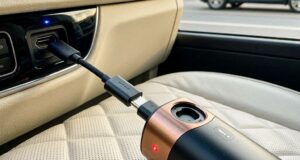
When looking to buy the best portable car vacuum, many car owners naturally lean toward corded $12\text{V}$ models. The selling point is simple and highly compelling: unlimited runtime. Unlike cordless models that die mid-clean, a plug-in vacuum draws steady power directly from your vehicle’s accessory socket.
However, this design introduces a massive, often overlooked physical bottleneck: Cord Length Limitations.
There is nothing more frustrating than detailing your front seats, moving to the back, and then discovering the cord is physically too short to reach the vehicle’s trunk (diggi). Trying to clean deep cargo areas with a tight, overstretched cord turns a simple chore into a physical struggle.
Below is an in-depth, point-to-point breakdown of the modern challenges surrounding cord length limitations, how it impacts larger vehicle owners, and the technical hurdles of long-cord designs.
1. The SUV and Hatchback “Trunk Chasm”
The standard length for most corded car vacuum cables is around 11 to 14 feet (3.4 to 4.2 meters). While this seems sufficient on paper, real-world vehicle dimensions present a different story.
- The Length Deficit: A mid-size SUV or minivan can easily measure 16 to 18 feet from the front dashboard to the rear tailgate.
- The Zig-Zag Path: Cables do not travel in a straight, unobstructed line. They must weave around center consoles, seat bolsters, headrests, and child seats. This routing eats up several feet of cord length, making it practically impossible to reach the deep corners of the trunk (diggi).
2. Voltage Drop Over Long Cables (The Copper Wire Trade-off)
To solve the reach problem, users often wonder why manufacturers don’t simply ship vacuums with 30-foot cords. The challenge lies in fundamental electrical physics: Voltage Drop.
- The Physics Barrier: Direct current ($12\text{V}$ DC) experiences significant resistance when traveling through thin copper wires. The formula for voltage drop is:$$V_{\text{drop}} = \frac{2 \cdot L \cdot I \cdot R}{1000}$$(where $L$ is wire length, $I$ is current, and $R$ is wire resistance per unit length).
- Power Degradation: Pushing $12\text{V}$ through a very long, thin cable causes the voltage to drop by the time it reaches the motor. A vacuum that starts with $12\text{V}$ at the plug might receive only $9.5\text{V}$ at the motor if the cord is too long, severely diminishing its suction power.
- The Cost of Thick Copper: To prevent voltage drop, manufacturers would have to use thick, heavy-duty low-gauge wires. This would make the power cord incredibly bulky, stiff, and highly expensive to manufacture.
3. The “Seat-Hanging” Cable Catch
Cleaning a car is an active, highly dynamic physical process. Short cords restrict your freedom of movement.
- Snagging and Tangling: A cord that is stretched to its absolute limit acts like a tripwire inside your vehicle’s cabin. It snags on seat adjusters, door pockets, gear shifters, and seat belts.
- Damaged Sockets: Pulling hard on a highly tensioned cable to reach the trunk puts severe mechanical strain on both the vacuum’s male plug and your car’s sensitive $12\text{V}$ auxiliary outlet. This constant pulling can crack the plastic socket collar or loosen the internal contacts, leading to dangerous electrical sparking.
4. Inconvenient Auxiliary Socket Placements
The reach of your vacuum is entirely dependent on where your car manufacturer decided to place the $12\text{V}$ cigarette lighter socket.
- Front-Heavy Configurations: Many modern cars only feature a single $12\text{V}$ port located right beneath the dashboard console.
- The Forgotten Trunk: Unless your vehicle has a secondary $12\text{V}$ port specifically located in the rear cargo area (a feature rarely found in budget sedans or compact cars), you are completely dependent on routing the cord all the way from the front windshield to the back trunk.
5. Dangerous “Tension” Wire Splits
When users aggressively pull on a cord that has run out of slack to reach that one last dirty corner of the trunk, they cause internal structural damage.
- Copper Micro-Fracturing: Constant physical pulling weakens the delicate copper strands inside the insulated rubber casing.
- Intermittent Power and Shorts: Over time, these strands fracture. This leads to a vacuum that cuts out whenever you turn the handle, or worse, creates a direct electrical short circuit that instantly blows your car’s fuse.
[Front 12V Socket] ───────(Obstacles: Seats, Console)───────> [Tight Cord] ──(Tension Pull)──> [No Trunk Access]
       │                                                                                    │
       └──────────────(Voltage Drop on Thin Wire)─────────────> [Weakened Suction Power] <──┘
Pro-Tips: How to Solve Cord Reach Issues
If you prefer a plug-in model but struggle to clean your vehicle’s trunk, implement these smart solutions:
- Prioritize Cord Specs When Buying: When shopping for the best portable car vacuum, filter your options by looking for models that specifically feature a 16-foot (5-meter) cord or longer.
- Use a Heavy-Duty 12V Extension Cable: You can purchase aftermarket $12\text{V}$ cigarette lighter extension cables. If you go this route, ensure the extension cable uses thick 14 AWG or 16 AWG wire to minimize voltage drop and maintain high motor suction.
- Utilize Rear USB-C Ports (With Adapters): Some modern vehicles have USB-C ports in the rear passenger seats. While these cannot directly power a $12\text{V}$ corded vacuum, they can be utilized to recharge cordless hybrid models right where you need them.
- Consider a Hybrid Cordless Model: If your budget allows, opt for a high-suction cordless vacuum that can be charged via USB-C. This completely eliminates the cord limit, giving you $100\%$ unrestrained mobility to detail your trunk, wheel wells, and engine bay without any physical limits.
Cord length limitations are the ultimate buzzkill for corded car vacuums. While direct $12\text{V}$ power saves you from the anxiety of dying batteries, it locks you into a physical radius dictated by your car’s cabin size. Finding the best portable car vacuum means finding a balance—either by selecting a corded model with a highly generous, low-resistance cable, or transitioning to a modern high-suction cordless unit that frees you from the physical limits of the cabin.