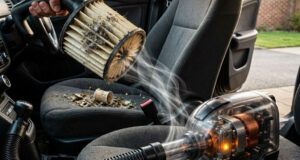
If you own a dog or a cat, your vehicle’s cabin is constantly under siege from shed fur. When searching for the best portable car vacuum, most pet owners expect a quick pass over the upholstery to leave their seats looking brand new. Instead, they run into a highly frustrating reality: Pet Hair Embedding.
Unlike loose crumbs, pet hair does not just sit on top of your seats. It weaves itself directly into the fabric like tiny barbed needles. Standard handheld vacuums—even those boasting high suction ratings—often slide right over these embedded hairs without pulling a single strand loose.
Below is an in-depth, point-to-point breakdown of the physical, mechanical, and electrical challenges of pet hair extraction from car interiors, and how to overcome them.
1. The Mechanical Weaving Hazard (The Needle Effect)
Pet fur is not smooth. Under a microscope, individual animal hairs have tiny, overlapping cuticle scales that act like backward-facing barbs.
- Fabric Interlocking: Car seats are made of tightly woven synthetic fibers (like polyester, nylon, or velour) designed for durability.
- The Needle Action: When a pet sits on the seat, their weight forces these barbed hairs into the tiny gaps of the fabric weave.
- The Physical Lock: Once a hair slips beneath the surface, its microscopic barbs hook into the fabric fibers. Pure suction pressure—even from a high-power vacuum—lacks the physical leverage to “unweave” these locked hairs without some form of physical agitation.
2. Electrostatic Cling (The Invisible Magnet)
Car interiors are major breeding grounds for static electricity, which turns your seats into magnets for pet fur.
- Friction buildup: The sliding motion of passengers getting in and out of the car, combined with the movement of your pet, generates static electricity across the seat upholstery.
- The Charge Bond: Synthetic fabrics and animal fur hold opposing electrical charges. This difference creates a powerful electrostatic bond that tightly holds the hair flat against the fabric.
- Suction Defeat: Low-to-mid tier vacuums do not have the power to break this electrostatic charge, leaving the hair securely bound to the seat despite maximum airflow.
3. The Lack of Motorized Brush Rollers in Portable Designs
Most domestic upright vacuums clean pet hair easily because they utilize a motorized, spinning brush roll to beat the carpet fibers. Portable car vacuums, however, struggle with this mechanical requirement.
- Passive vs. Active Brush Heads: Most compact car vacuums only ship with passive, clip-on plastic brushes. These brushes must be scraped manually across the seat.
- Inefficient Scrubbing: Manual scraping is exhausting, slow, and often only pushes the hair deeper into the weave instead of lifting it into the air path.
- Power Limits: Adding a dedicated motorized brush head requires an independent motor inside the attachment. This draws extra wattage from the battery, significantly reducing the runtime of cordless devices.
4. Rapid Filter Clogging and Dander Air-Blockage
Pet hair rarely travels alone; it is almost always accompanied by microscopic dander (shed skin cells).
- Pore Blockage: When you vacuum pet hair, the lightweight fur and dander are pulled into the dust canister.
- The Static Mesh: Instead of dropping into the bin, static electricity causes the hair to wrap tightly around the internal HEPA filter mesh.
- Instant Suction Drop: This creates an immediate physical barrier over the filter pores. Airflow drops rapidly, and the vacuum loses its ability to lift any remaining embedded hairs.
5. Hair Tangling and Motor Overload (The Roller Jam)
For premium portable vacuums that do feature a miniature motorized brush head, long pet hair presents a mechanical durability challenge.
- The Axle Wrap: Long fur from breeds like Golden Retrievers or Persian cats wraps tightly around the spinning brush roll axle.
- Increased Friction: As hair wraps around the spindle, it creates immense rotational friction, slowing down the brush motor.
- Thermal Cut-off: This friction forces the vacuum’s internal motor to pull more current to maintain its speed, leading to overheating, rapid battery drain, or a complete thermal shutdown.
[Barbed Pet Hair] ──> [Weaves into Fabric Weave] ──> [Electrostatic Bond]
                                                              │
[No Motorized Brush] <── [Pure Suction Fails] <───────────────┘
Professional Detailing Tactics: How to Pull Out Embedded Hair
If your pet travels with you frequently and you want your detailing sessions to be successful, combine your best portable car vacuum with these professional methods:
- Use a Dedicated Rubber Tool First: Before turning on your vacuum, scrape the seats with a rubber pet hair removal brush, a squeegee, or even a dry rubber glove. Rubber creates massive friction and a localized electrostatic charge that pulls the embedded barbs out of the weave and rolls the hair into neat clumps.
- Select a Vacuum with a Motorized Pet Head: If pet hair is your main concern, look specifically for vacuums that feature a dedicated, motorized mini brush attachment (often called a “Pet Power Brush” or “Tangle-Free Brush Roll”). These active rotating bristles physically lift and pull hair from the fabric.
- Detail in a Cross-Hatch Pattern: Never vacuum in just one direction. Run your vacuum nozzle in a cross-hatch pattern—vertically, then horizontally. This pulls at the woven hair from multiple angles, increasing the chance of releasing the mechanical lock.
- Mist with Fabric Softener: For extremely stubborn areas, lightly mist the seats with a mixture of water and a few drops of liquid fabric softener. Fabric softener is specifically formulated to break down static charges and relax fabric fibers, allowing the embedded hair to slip out easily.
Pet hair embedding is one of the toughest challenges in automotive detailing. Because of the physical structure of animal fur and the static charges of synthetic fabrics, pure suction power is rarely enough to get the job done. To find the best portable car vacuum for a pet-friendly household, you must look for active mechanical agitation, such as motorized brush attachments, or assist your vacuuming sessions with high-friction rubber tools. Taking these steps will help you easily remove even the most stubborn embedded fur.