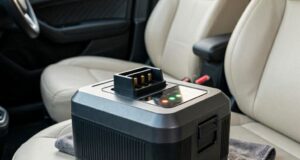
You pull out your sleek handheld vacuum to clear out some dry mud and loose fries from under the seat. Five minutes in, the handle feels like a fresh cup of espresso, the exhaust smells slightly like burnt plastic, and the motor just dies.
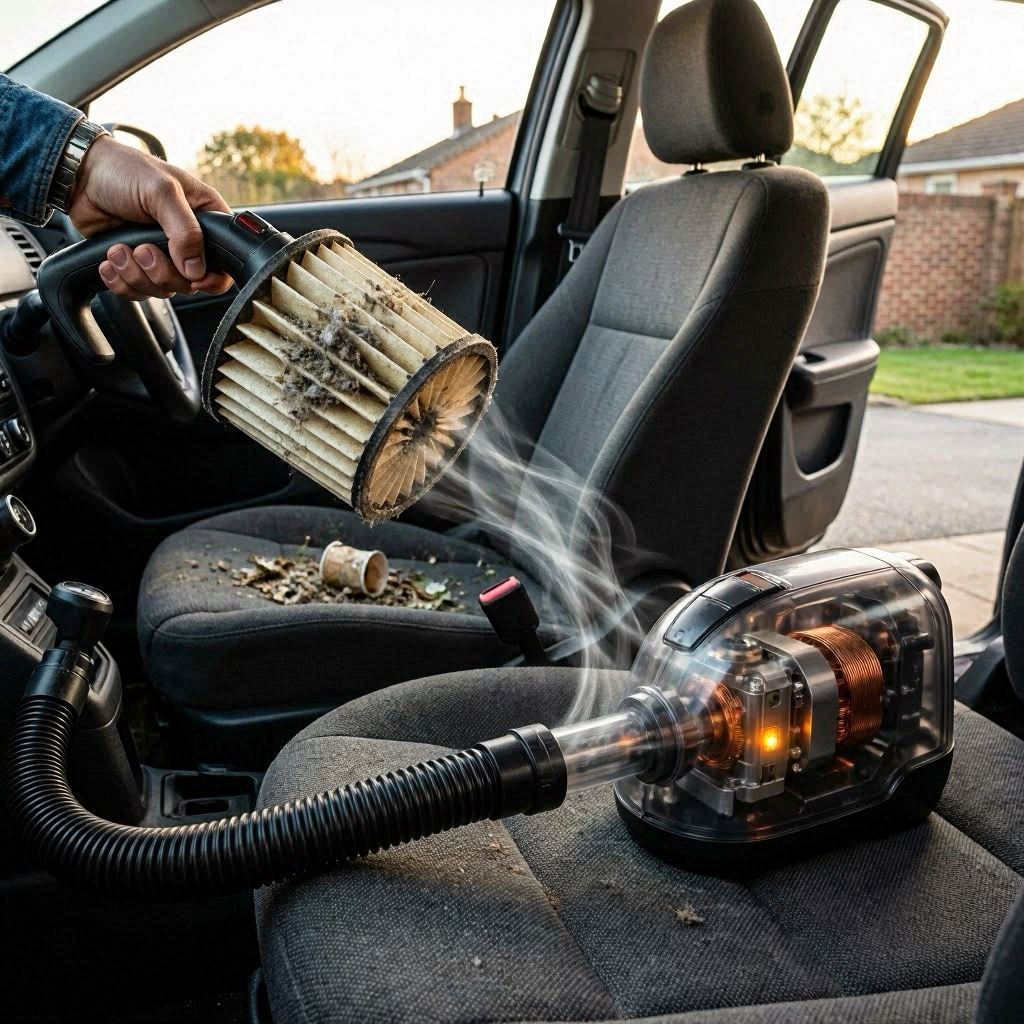
If you are dealing with a machine that turns into a mini radiator within minutes, you are not alone.
While heavy household vacuums have large housings to dissipate thermal energy, compact car cleaners operate in a completely different, unforgiving environment. To fix this, you need to look beyond generic advice like “empty the bag.”
Let’s dissect the real engineering bottlenecks, modern usage blunders, and the exact roadmap to keep the best portable car vacuum running ice-cold.
1. The Core Engineering Bottleneck: High RPM vs. Zero Breathing Room
To understand the rapid temperature spike, you have to look at how modern portable vacuums are designed.
To achieve high suction (measured in Pascals, like 8,000 Pa to 15,000 Pa) inside a body no bigger than a water bottle, manufacturers use high-velocity brush motors or brushless digital motors spinning at up to 100,000 RPM.
[Suction Port] ---> [Fine Filter Mesh] ---> [High RPM Compact Motor] ---> [Exhaust Vents]
         ^                    ^                         |                      ^
   (Micro-Clogs)       (Air Strangled)         (Generates Max Heat)     (Heat Trapped Inside)
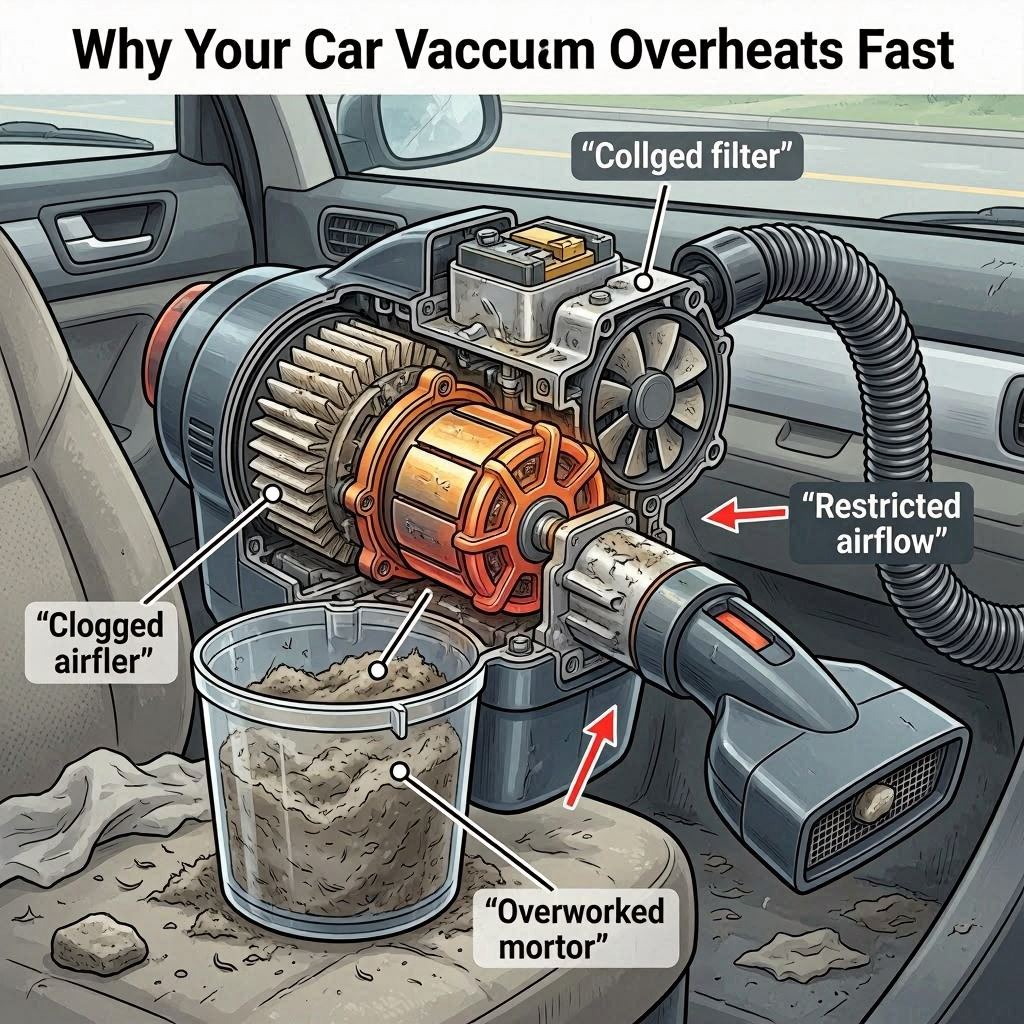
Unlike large home vacuums, a portable unit uses the very air it sucks in to flow over the motor housing and cool it down.
- The Trap: When you compress dust, ash, and pet dander into a tiny, palm-sized container, the airflow drops instantly by 50% or more.
- The Reaction: Less air passing through means the motor loses its primary cooling mechanism while working twice as hard against the resistance. The result is an immediate thermal runaway.
2. Real-World Challenges & Hidden Overheating Triggers
If your device is overheating abnormally fast, the culprit is usually one of these modern car-cleaning challenges:
The “Invisible Wall” of HEPA Filters
Most premium car vacuums utilize dense HEPA filters to trap fine dust. While excellent for air quality, ultra-fine cabin dust acts like concrete when mixed with humidity inside a car. It forms a thin, microscopic crust over the filter pores. The vacuum looks empty to your naked eye, but the motor is effectively trying to breathe through a brick wall.
The 12V DC Voltage Drop Strain
If you are using a corded model that plugs into your car’s cigarette lighter socket, unstable voltage can generate massive heat. If your car engine is turned off, or if your socket has corroded contacts, the voltage drops. To maintain its power output, the motor draws more current (amperage). Higher current equals an immediate, aggressive rise in wiring temperature.
Lithium-Ion Thermal Stacking (For Cordless Units)
Cordless models run on high-drain lithium batteries. Batteries naturally get warm when discharging. Because the battery packs are packed tightly right next to the high-RPM motor inside the small handle, you get a “thermal stacking” effect. The motor heats the battery, the battery heats the motor, and the internal thermal switch triggers a shutdown.
3. Step-by-Step Diagnostic Framework to Cool It Down
Before throwing away your investment, run through this specialized diagnostic checklist to isolate the heat source:
| Diagnostic Step | What to Check | Why it Matters |
| Step 1: The Sunlight Test | Hold the washed and dried filter up to a bright light. | If light doesn’t pass through clearly, microscopic pores are still choked with fine ash/dust. Replace it. |
| Step 2: Port & Duckbill Inspection | Check the rubber flap (duckbill valve) inside the suction nozzle. | Sometimes this flap gets stuck halfway, acting as an intentional blockage that chokes the airflow. |
| Step 3: Battery Cool-Down Check | Feel the handle right after taking it off the charger. | If it’s warm before you turn it on, you are starting the cleaning session already near the thermal limit. |
4. Operational Best Practices: How to Protect Your Machine
To get the absolute maximum lifespan out of the best portable car vacuum, shift your cleaning strategy from a single long session to structured, tactical bursts.
The “Zone Defense” Cleaning Method
Do not turn the vacuum on and keep it running for 20 minutes straight while you reposition floor mats and wipe down dashboards. Instead, use the 3-on, 1-off rule:
- Run the vacuum continuously for a maximum of 3 to 4 minutes to clean a specific zone (e.g., driver’s footwell).
- Turn it completely off while you move to the back seat, shake out the mats, or adjust your attachments. This brief 30-second window lets the internal components rest and stabilizes the temperature.
Avoid the “Deep Press” Suction Seal
When trying to pull dirt out of deep car carpets, the natural instinct is to press the nozzle flat against the floor fabric. This is a fatal mistake for a small handheld. Sealing the nozzle entirely stops all air from entering. Without air intake, the motor free-spins in a vacuum state, drawing massive energy and overheating within 60 seconds. Always maintain a slight angle to allow continuous air movement.
Extreme Weather Storage Warning
Never store your portable vacuum inside a hot car trunk during summer. If the ambient temperature inside the vehicle is already 45°C (113°F), the plastic housing, motor components, and lithium batteries are already heat-soaked before you even press the power button. Store it in a cool, shaded spot indoors.
A hot car vacuum isn’t always a broken one; it is usually a suffocating one. By treating the filter as a critical component, managing your runtime intervals, and ensuring your power supply or battery pack isn’t working in a pre-heated environment, you can stop the rapid thermal shutdowns entirely. Keep the airways clear, let the motor breathe, and your compact cleaner will easily survive the toughest detailing sessions.