
You plug your handheld vacuum into the charging cable, wait until the green light solidifies, and unplug it, expecting a powerful cleaning session. Instead, you get a weak, three-second spin before the motor dies completely. You plug it back in, and the charger claims it is already full.
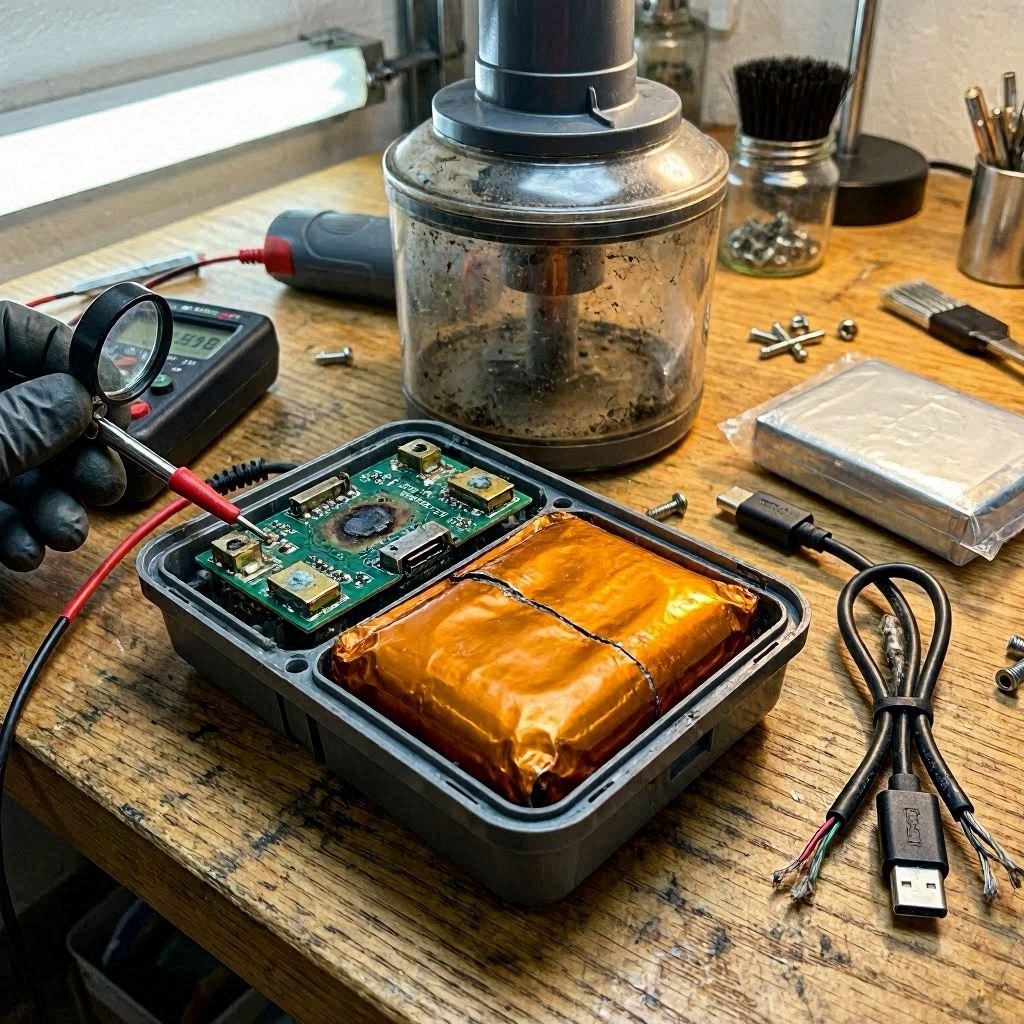
This frustrating loop is not a glitch; it is a definitive sign of battery chemistry failure.
When a portable cleaner refuses to hold its capacity, the issue stretches far beyond simple usage fatigue. Because these compact devices are subjected to brutal temperature shifts inside vehicles and rapid power-draw cycles, their power cells experience unique wear that standard household electronics never encounter.
To help you rescue your hardware or avoid making the same mistakes with your next purchase, let’s look at the underlying science of battery degradation, the modern issues that ruin these cells, and the direct answers to common user frustrations.
1. The Internal Chemistry Collapse: Why Batteries Lose Storage Capacity
To diagnose a vacuum that won’t hold a charge, you have to look at what happens inside the lithium-ion (Li-ion) or Nickel-Metal Hydride (NiMH) cells packed into the handle.
Healthy Cell:   [Lithium Ions Moving Freely]  ---> [High Voltage Output] ---> [Stable 20-Min Run]
Degraded Cell:  [Crystalline/Plating Barrier] ---> [Instant Voltage Drop] ---> [3-Second Power Die]
Inside a healthy battery, lithium ions move smoothly between the negative and positive electrodes during charge and discharge cycles. However, several internal anomalies can permanently disrupt this flow:
- Lithium Plating: When a vacuum is left on a cheap, non-intelligent charger for days, extra lithium accumulates on the anode surface instead of inserting itself correctly. This turns active energy-storing material into dead, metallic lithium crust.
- Internal Resistance Spike: As the cell ages or suffers from thermal stress, its internal resistance increases. When the motor tries to draw power, this resistance causes an immediate, massive drop in voltage. The internal protection circuit mistakes this drop for an empty battery and cuts power instantly, even though the cell is technically “full” of unusable energy.
2. Modern Automotive Environmental Hazards and Structural Challenges
Car maintenance gear faces a much tougher operational environment than a standard living-room stick vacuum. These specific factors accelerate charge loss:
The Extreme Trunk Thermal Cycle
Vehicles left out in the sun act as literal ovens. If your vacuum sits in a trunk or glovebox where ambient temperatures fluctuate between 10°C at night and 60°C during the day, the heat triggers continuous, microscopic chemical reactions inside the battery cells. This causes accelerated self-discharge, permanently lowering the total amount of energy the pack can physically hold.
Micro-Vibration Degradation
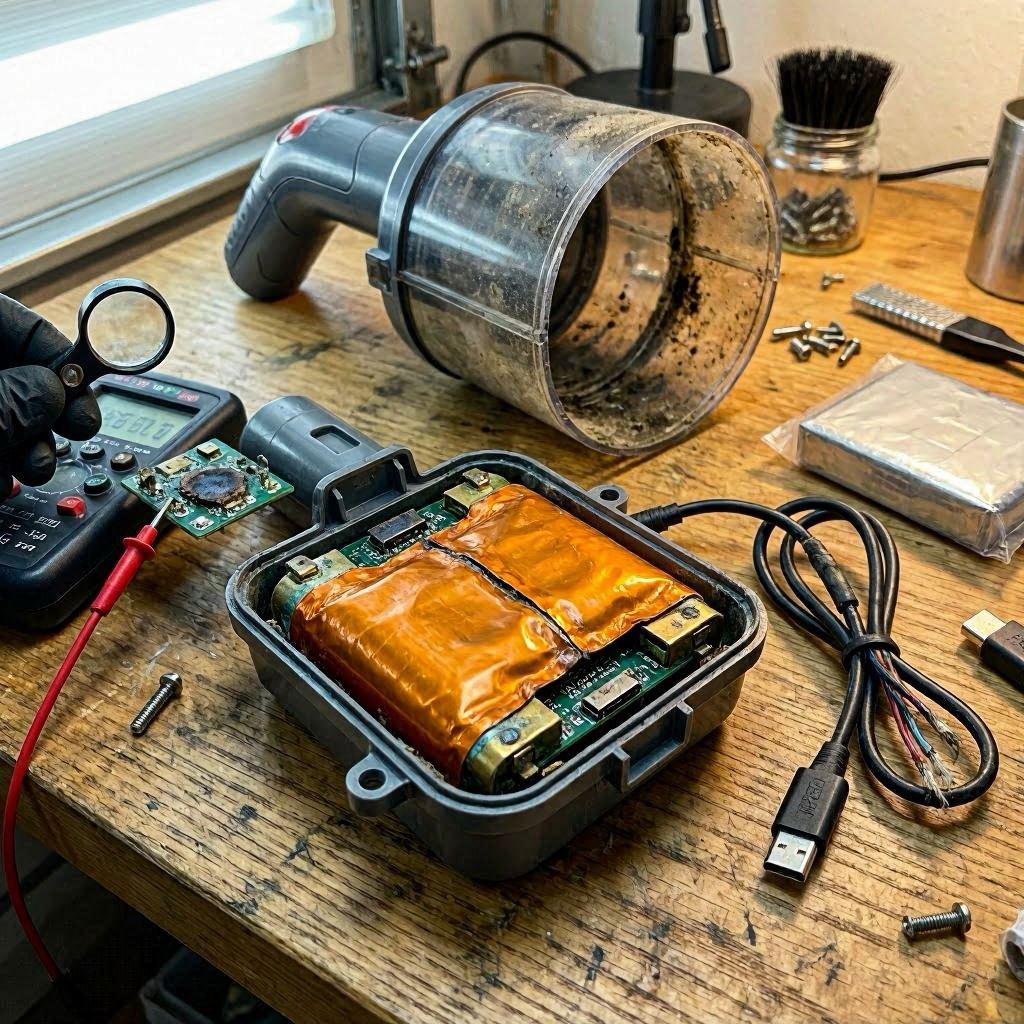
Car vacuums bounce around in trunk organizers, door pockets, and floorboards over bumps, potholes, and rough roads. Continuous physical vibrations can hairline-fracture the delicate internal solder joints or nickel strips that connect the individual battery cells in series. The cells themselves might be fine, but the broken connection prevents the charging current from reaching them evenly.
The “Deep Sleep” Voltage Drop
If you only vacuum your car once every three months, the device sits unused for long stretches. Lithium cells naturally slow-bleed energy over time. If the battery voltage drops below a critical threshold (typically around 2.5V per cell), the built-in Battery Management System (BMS) enters a permanent self-protection mode. It locks the battery down to prevent a fire hazard, rendering it completely unchargeable by consumer cords.
3. Systemic Diagnostics: Tracking the Charging Failure
Before throwing your equipment into the recycling bin, execute this precise mechanical checklist to pinpoint exactly where the power chain is breaking down:
| Diagnostic Test | What You See | The True Root Cause |
| The Immediate Rebound Test | The vacuum dies in 10 seconds, but registers 100% full after just 5 minutes on the charger. | High internal resistance. The cell chemistry is completely depleted and cannot handle a heavy current draw. |
| The Cold Cord Analysis | The charger brick or USB interface stays completely cold to the touch during a 2-hour plug session. | The charging port on the vacuum is physically damaged, loose, or the internal BMS fuse has blown. No current is passing through. |
| The Ghost Drain Inspection | You charge the unit fully indoors, leave it off for three days, and find it completely dead without ever turning it on. | An internal parasitic short-circuit within the circuit board is slowly bleeding power to the ground plane. |
4. Addressing Clear Concerns (Objections & Answers)
Objection 1: “I bought the best portable car vacuum on the market, and it still stopped holding a charge after six months. Expensive brands shouldn’t fail this quickly.”
Answer: Brand tier does not exempt lithium chemistry from the laws of physics. If a premium vacuum is stored inside a baking car during peak summer months, or if it is regularly left plugged into a live 12V dashboard socket while the car is running (causing continuous micro-voltage spikes), the internal cells will degrade at the exact same rate as a budget model. Storage habits dictate lifespan far more than the price tag.
Objection 2: “Can’t I just open up the plastic casing and swap out the dead internal battery cells with regular rechargeable AA batteries to fix it?”
Answer: Absolutely not. Standard consumer AA rechargeable batteries (usually NiMH or Alkaline chemistry) operate at vastly lower voltages and cannot supply the high continuous discharge current (often 10 to 15 Amperes) required by a high-RPM car vacuum motor. Trying to modify the power source without an exact matched lithium pack will fail to start the motor or fry the internal control board entirely.
Objection 3: “The green light on my charging dock turns on, which proves the internal battery cells are perfectly healthy and accepting juice, right?”
Answer: No. The green light merely indicates that the charger has reached its target termination voltage (e.g., 12.6 Volts). It does not measure the actual volume of ions stored. A completely worn-out battery can reach its target voltage almost instantly because it has no capacity left to absorb current—similar to how a tiny shot glass fills up instantly compared to a large water bucket.
5. Strategic Protocols to Maximize Future Battery Lifespan
If you are replacing your unit or managing a functional one, adopt these structural operational habits to protect the storage core:
- The 80/20 Optimal Storage Rule: Do not store your handheld vacuum completely empty or permanently maxed out at 100% for months at a time. If you plan to store it over winter or between long trips, charge it to roughly 50% to 80% capacity. This minimizes structural stress on both the anode and cathode materials.
- Enforce a 15-Minute Thermal Cool-Down: Never plug your vacuum directly into a charger immediately after a heavy cleaning session while the handle is still hot. Similarly, never turn the vacuum on immediately after pulling it off a fast charger. Let the cells stabilize to ambient room temperature before changing states.
- Climate-Controlled Boarding: Treat your car vacuum like sensitive laptop electronics. When you finish detailing your car mats, bring the device indoors to a climate-controlled room or garage shelf rather than leaving it to face extreme seasonal weather inside the vehicle cabin.
A portable car vacuum that won’t hold a charge is rarely a failure of the motor itself; it is the natural consequence of chemical degradation, thermal stress, or improper storage cycles. By understanding that compact lithium cells require thermal protection, avoiding continuous overcharging patterns, and checking for mechanical connection faults, you can ensure your detailing gear stays fully energized and ready for action when you need it most.