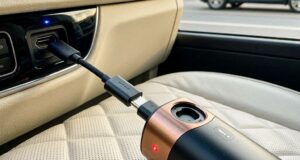
When searching for the best portable car vacuum, we often analyze performance metrics like suction power, weight, and portability. However, there is a glaring pain point that manufacturers frequently hide in the fine print: Prolonged Charge Cycles.
It is a massive operational bottleneck when a handheld vacuum takes 3 to 5 hours to charge, only to provide a mere 15 to 20 minutes of runtime. This disproportionate ratio of “charge-to-use” time is one of the greatest challenges facing the cordless car cleaning industry today.
Below is a point-to-point technical and practical analysis of why portable car vacuums take so long to charge, the modern engineering bottlenecks keeping them slow, and how this affects your car-detailing workflow.
Key SEO Keywords Target
| Primary Keyword | Secondary Keywords | LSI Keywords |
| best portable car vacuum | cordless vacuum slow charging | lithium-ion battery charge rate |
| handheld car vacuum charge time | CC/CV charging profile | |
| high-power cordless car vacuum | USB-C Power Delivery limitations |
1. The Asymmetry of the “Charge-to-Discharge” Ratio
The most frustrating user experience with cordless vacuums is the mathematical mismatch between how fast energy is consumed versus how slowly it is replenished.
- Ultra-Fast Depletion: A high-suction motor drains battery cells rapidly, drawing current at high rates (often $5\text{C}$ to $10\text{C}$ discharge rates) to pull dirt out of car carpets.
- Glacial Replenishment: While the vacuum can empty the battery in 12 minutes, chemistry dictates that recharging those same cells safely must happen at a much slower rate (typically $0.5\text{C}$ to $1\text{C}$). This results in a frustrating 1:15 ratio (where 15 minutes of cleaning requires over 3.5 hours of charging).
2. The CC/CV Charging Protocol Bottleneck
Almost all modern lithium-based vacuums rely on a two-stage charging algorithm called Constant Current / Constant Voltage (CC/CV).
- The Quick Stage (Constant Current): The charger pumps a steady, high current into the battery up to about $80\%$ capacity. This stage is relatively fast.
- The Slow Squeeze (Constant Voltage): Once the battery hits $80\%$, it enters the Constant Voltage stage. To prevent overcharging and thermal runaway, the charger must slowly taper off the electrical current.
- The Final Stretch: Topping off that last $20\%$ can take just as long as charging the first $80\%$, keeping the device locked to a power outlet for hours before you can finish detailing your vehicle.
3. The USB-C 5V Charger Misconception
Many of the best portable car vacuum models marketed today feature a convenient USB-C port, leading users to believe they will charge as fast as their smartphones.
- Voltage Mismatch: Standard USB ports on laptop chargers or car dashboards typically output only $5\text{V}$ at $1\text{A}$ or $2\text{A}$ ($5\text{W}$ to $10\text{W}$ of power).
- Step-Up Strain: A standard multi-cell vacuum battery pack requires anywhere from $11.1\text{V}$ to $18\text{V}$ to charge. Pushing a $5\text{W}$ power source uphill to charge an $18\text{V}$ battery pack is highly inefficient, resulting in excruciatingly long recharge times of up to 5 to 6 hours.
4. Passive Thermal Management in Compact Enclosures
As discussed, heat is the ultimate enemy of lithium-ion batteries. Charging a battery generates significant internal heat due to chemical resistance.
- No Active Cooling: Unlike electric vehicles or laptops, ultra-compact car vacuums do not have active cooling fans inside their handles.
- BMS Safety Throttling: To prevent the battery cells from cooking themselves inside their sealed plastic housings, the Battery Management System (BMS) deliberately throttles the charging current. This safety precaution directly increases the total time the vacuum must remain plugged into the wall.
5. Cheap charging circuitry in budget-tier models
To keep retail prices appealingly low, budget-friendly cordless car vacuums cut corners on the internal charging motherboard.
- Lack of Smart Handshakes: Premium devices use dedicated Power Delivery (PD) controllers that negotiate with fast chargers to safely pull higher wattages (e.g., $9\text{V}/2\text{A}$ or $12\text{V}/1.5\text{A}$).
- Defaulting to Slowest Speeds: Cheap models lack this “handshake” protocol. When plugged into a high-speed brick, they fail to negotiate, default to the safest, lowest common denominator of power ($5\text{V}/1\text{A}$), and charge at a crawl.
[Power Outlet] ──(Low 5W Input)──> [Passive Plastic Shell] ──(Heat Trapping)──> [BMS Throttles Current] ──> [Prolonged Charge Cycle]
Detailing Tactics: Managing the Prolonged Charge Dilemma
If you are looking to buy or currently use a cordless model, here is how you can mitigate the long downtime:
- Invest in True USB-C PD Models: When shopping for the best portable car vacuum, look for models that explicitly state support for USB-C PD (Power Delivery) at $18\text{W}$ or higher. This cuts charge times down to under 1.5 hours.
- Look for Removable/Swappable Batteries: Some premium brands offer swappable battery packs. Having a secondary battery charging while you use the first completely eliminates downtime.
- Charge Indoors, Not in the Car: Car USB outlets are notoriously low-powered. Bring the vacuum inside and use a high-quality wall block to charge it instead of relying on your car’s auxiliary ports.
- Adopt the 80% Rule for Quick Detailing: If you only need to do a quick spot-clean of your floor mats, don’t wait 4 hours for a full charge. Unplugging the vacuum at $80\%$ SoC (State of Charge) saves you hours of waiting time and actually preserves battery health.
Prolonged charge cycles remain a massive logistical challenge in the cordless detailing space. Until fast-charging, heat-resistant lithium-chemistry is universally integrated into compact form factors, users must balance convenient cordless designs with long charging times. By choosing vacuums with advanced BMS chips, Power Delivery compatibility, or swappable batteries, you can bypass this bottleneck and keep your car spotless without the endless wait.