
You are halfway through detailing your front passenger footwell. You wedge the crevice tool deep into the track under the seat, hunting for that spilled collection of dry dirt, beach sand, or pet kibble. The motor is revving high, and you think you’re winning the battle against the debris.
Then you catch a sudden cough. You look up, squinting into the sunlight cutting through your windshield, and notice a fine mist of dust, ash, and gray powder blasting directly out of the vacuum’s rear exhaust vents. A second later, you hear a violent rattle, and three sharp pebbles shoot backward out of the intake nozzle, bouncing straight off your freshly wiped dashboard.
When consumers search for the best portable car vacuum, they evaluate metrics that feel premium on paper: high Pascal (Pa) suction ratings, elegant matte finishes, and lightweight chassis configurations. Almost no one tests the integrity of the exhaust path or the internal backflow seal. Yet, “car vacuum spitting out dirt” remains one of the most maddening, overlooked design flaws in the mobile detailing market.
Vehicles expose vacuum cleaners to high-density, sharp, and micro-fine debris that standard household dust busters never encounter. Here is the raw, point-to-point teardown of why your car vacuum has turned into a dirt launcher, the mechanical vulnerabilities causing it, and how to keep the grime inside the bin where it belongs.
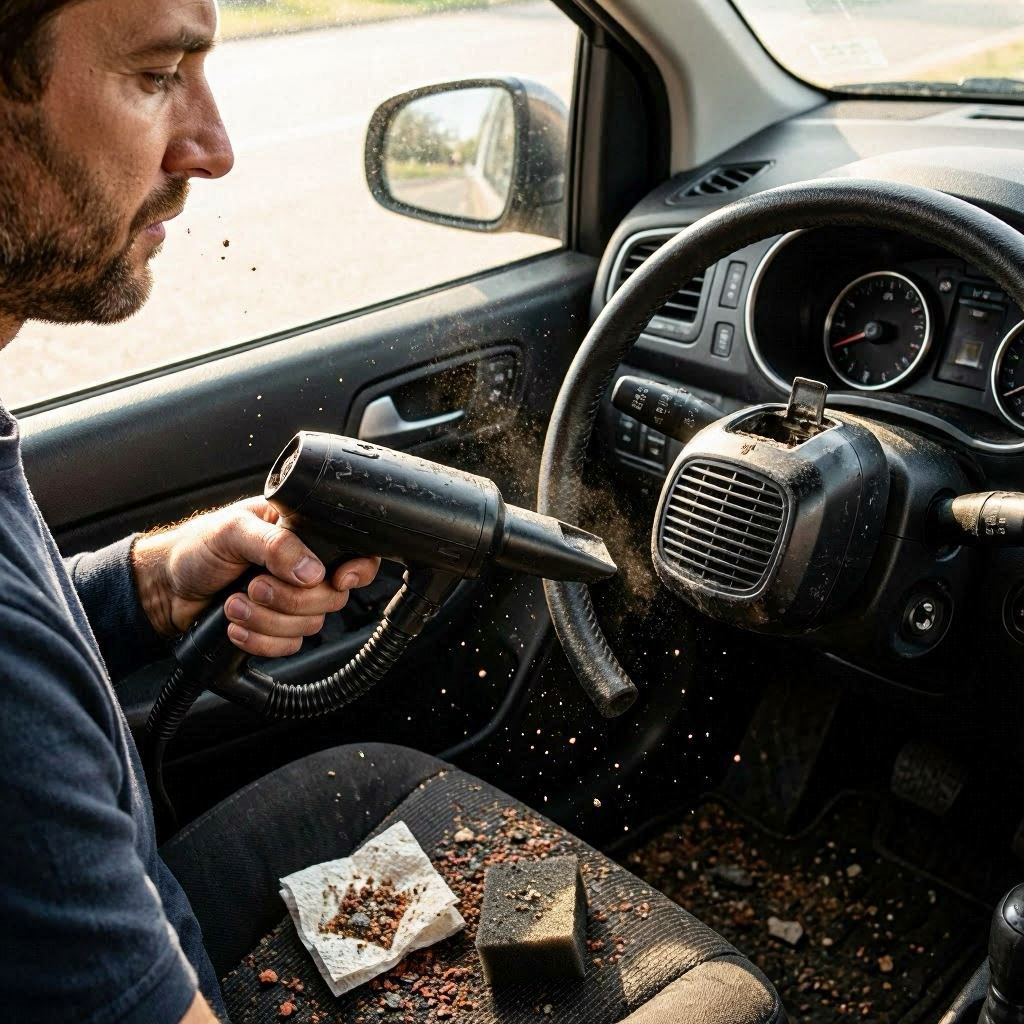
1. The Catastrophic Failure of the Intake Check-Valve
Inside the nozzle intake of almost every handheld cleaner sits a small, low-cost component called a rubber check-valve or flap gasket. This tiny flap is the only thing standing between the dirt bowl and your clean car interior.
- The Basic Mechanic: When you turn the vacuum on, the internal air pressure pulls the rubber flap open, allowing sand and dirt to rush into the collection cup. When you cut the power, the air pressure drops, and gravity is supposed to snap the flap shut, locking the debris inside.
- The Automotive Jam: Because car detailing involves picking up long, stiff debris like pine needles, brittle twigs, dog hair, or stray french fry edges, these items rarely settle flat at the bottom of the cup. Instead, they get wedged directly across the intake throat.
- The Reverse Spill: The moment you tilt the vacuum upward to reach a sun visor or turn the power off to move to the back seat, the jammed object keeps the rubber flap propped wide open. Gravity takes over, and the entire payload of abrasive road sand slides right back down the nozzle and onto your clean seats.
2. The 2026 Micro-Silt Exhaust Bypass (The HEPA Tear)
If your vacuum isn’t dropping heavy pebbles out of the front nozzle but is instead blowing a cloud of fine gray smoke out of the back vents, you are dealing with a compromised internal seal.
High-Velocity Intake of Sharp Road Grit (Gravel / Silt)
       │
       ├──► Debris hits the internal plastic cyclonic cone at high speed
       │
       └──► Sharp micro-fragments puncture or tear the thin paper HEPA pleats
               │
               └──► Exhaust air path finds the path of least resistance (The Tear)
                       │
                       └──► Micro-silt sprays directly out of the rear vents into the cabin
- The Projectile Effect: Road silt tracked in from construction sites, gravel driveways, or highway asphalt contains sharp, crystalline quartz and silica fragments. When pulled into a high-RPM miniature vacuum, these micro-stones spin inside the cup like shrapnel.
- The Paper Breach: To achieve ultra-compact profiles, many devices marketed as the best portable car vacuum utilize paper-thin, unreinforced HEPA filters. The sharp quartz fragments easily puncture the delicate paper pleats.
- The Bypass: Once a microscopic tear forms, the intense exhaust air pressure bypasses the filtration web entirely. The vacuum transforms into a localized dust storm, aerosolizing hazardous fine dust directly into the closed cabin of your car.
3. High-RPM Exhaust Turbulences and Static Blowback
As brushless motor speeds hit unprecedented levels, the sheer velocity of air moving through miniature handheld vacuums has outpaced the physical capacity of their tiny dust collection chambers.
- The Vortex Overwhelm: In ultra-compact car vacuums, the distance between the intake nozzle and the exhaust filter is often less than three inches. When the motor runs at full tilt, the cyclonic vortex inside the tiny dust cup becomes too violent.
- Static Suspensions: Dry car interiors, synthetic upholstery, and fast-moving internal plastic fans combine to create massive static electricity inside the vacuum bin. This static charge keeps fine ash, pollen, and pet dander suspended in mid-air inside the cup instead of letting it drop to the bottom. Because the debris stays floating, the high-velocity exhaust air current drags it straight out through the rear mesh.
4. The Warped Housing Leak Paradox
Car vacuums live a brutal life compared to household appliances. They are routinely left inside glove boxes, center consoles, or hot trunks where interior vehicle temperatures can easily climb past 60°C (140°F) on a summer afternoon.
- Thermal Flexing: Handheld vacuums are constructed from layered injection-molded ABS plastic. Continuous exposure to extreme cabin heat cycles causes these thin plastic interlocking tabs and filter tracks to warp by mere fractions of a millimeter.
- The Air Path Defection: When you snap the dust bin back onto the motor housing after cleaning it, the warped tracks no longer form a true, airtight hermetic seal. The air stream escapes through these micro-gaps before it can ever pass through the filter, spraying raw, unfiltered dirt out of the seams of the vacuum body.

5. Debris Inversion Protocol: How to Secure Your Airflow
If your portable cleaner is actively contaminating your car interior during a detailing session, halt operation immediately and execute these mechanical fixes:
| Failure Symptom | Immediate Root Cause | Practical Action Steps |
| Large debris sliding back out of the front nozzle | Intake rubber flap jammed open by long debris | Remove the nozzle, clear out pinned twigs/hair, and clean the hinge |
| Fine dust cloud blowing out of rear exhaust vents | Punctured or torn paper filter element | Discard the compromised filter; replace with a steel-mesh reinforced unit |
| Dust escaping from the center seams of the chassis | Warped housing latches or misseated rubber O-ring | Realign the internal silicone gasket; check for true flush-click engagement |
6. How to Identify a Leak-Proof Portable Car Vacuum
If you want to replace your messy handheld unit with a reliable machine that retains its payload, ensure your next choice satisfies these structural requirements:
- Dual-Stage Filtration with Steel Pre-Filters: Never buy a car vacuum where raw dirt flies directly onto a paper filter. Look for models featuring a primary, ultra-fine stainless-steel mesh shroud that shields the internal HEPA filter. The steel stop-barrier catches sharp gravel and hair, preventing punctures and keeping the exhaust path completely pure.
- Weighted Gravity-Drop Check-Valves: Look for intake flaps that utilize a small metal weight or a spring-loaded hinge rather than a simple piece of flexible rubber. Weighted flaps snap shut aggressively the millisecond power drops, entirely preventing front-nozzle dirt spills.
- Rearward-Facing, Diffused Deflector Vents: The best portable car vacuum designs do not blast exhaust air straight out the back in a concentrated jet. They utilize multi-directional, upward-angled diffused vents that spread out the air velocity, ensuring the exhaust stream never blows down onto your dusty floor mats or up into your face.
A portable car vacuum that spits out dirt is a severe health and detailing hazard, turning trapped road grime into breathable airborne particulates. This blowback isn’t a sign of a weak motor; it is a mechanical failure born from torn filter walls, jammed intake gaskets, and heat-warped plastic housings. By switching to steel-shrouded filters, clearing out jammed debris from the intake throat after every run, and avoiding cheap paper elements that easily rip under the pressure of sharp road grit, you can keep your vehicle’s air clean and your detailing lines razor-sharp.