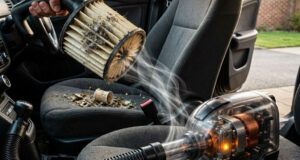
When consumers scour the market for the best portable car vacuum, they are usually driven by a single expectation: flawless cleaning performance. We picture a device effortlessly lifting everything from fine, microscopic clay dust to heavy gravel, small pebbles, and road salt brought in by our shoes.
However, when reality hits, many discover that their newly purchased handheld struggles to lift anything heavier than loose breadcrumbs.
This failure to perform is caused by Subpar Suction Pressure. Unlike static home vacuums, a car vacuum faces a highly complex battle against gravity, particle density, and carpet textures. When suction pressure drops below a critical threshold, the device simply skims over heavy debris, leaving fine dust embedded deep within the carpet fibers.
Below is a point-to-point analysis of the modern engineering and physical challenges of subpar suction pressure in portable car vacuums.
Key SEO Keywords Target
| Primary Keyword | Secondary Keywords | LSI Keywords |
| best portable car vacuum | low suction pressure handheld vacuum | static pressure vs airflow |
| car vacuum fine dust extraction | lifting heavy debris car detailing | |
| high-power car vacuum pascals | brushless motor suction drop |
1. The Dynamic Conflict: Pascals (Pa) vs. Airflow (CFM)
To understand why a vacuum fails to pick up a tiny pebble, we must look at the difference between two engineering metrics: Static Pressure (measured in Pascals or Pa) and Airflow (measured in Cubic Feet per Minute or CFM).
- The Pebble Problem (Requires Static Pressure): Lifting a heavy, solid object like a pebble requires high negative static pressure ($Pa$). This is the raw “vacuum force” needed to break gravity’s hold on a dense object.
- The Dust Problem (Requires Airflow): Sweeping up broad areas of light dust requires high airflow ($CFM$) to carry the particles through the air stream.
- The Handheld Dilemma: Due to their small batteries and compact motors, most portable vacuums cannot generate both. A model might have decent airflow but incredibly weak static pressure, leaving pebbles completely unmoved on your car mats.
2. Carpet Fiber Friction and Static Cling (The Interlocking Trap)
Car carpets are not smooth surfaces like hardwood floors. They are made of dense, looped synthetic fibers designed to trap dirt.
- Mechanical Interlocking: Fine dust particles, dried mud, and sand slip deep into the weave of car carpets. The fibers physically lock the particles in place.
- The Weak Pull: A substandard vacuum with suction under $6,000\text{ Pa}$ simply does not have the kinetic energy to break this physical lock. It passes over the surface, pulling only the loose top layer while leaving the deeply embedded dirt untouched.
3. The Cyclone Deficit in Compact Chambers
To maintain high suction, a vacuum must separate dirt from the air stream before the air hits the filter. This is done using cyclonic separation.
- Inefficient Cyclones: Because portable vacuums are engineered to be lightweight and compact, their internal cyclonic chambers are tiny and highly inefficient.
- Instant Filter Clogging: Instead of dropping into the dust cup, fine dust particles are pulled straight onto the HEPA filter mesh. Within 30 seconds of vacuuming fine dust, the filter pores block up, causing suction pressure to collapse immediately.
4. Nozzle Geometry and the Loss of “Vacuum Seal”
Suction pressure is highly dependent on maintaining a tight seal between the vacuum nozzle and the cleaning surface.
- Improper Nozzle Design: Many vacuums ship with wide, flat utility nozzles. While they cover more area, a wider opening dilutes the concentrated suction pressure.
- The Pressure Formula:$$\text{Pressure} = \frac{\text{Force}}{\text{Area}}$$If the surface area of the nozzle is too wide, the pressure drops exponentially. Without narrow, highly targeted crevice attachments to concentrate the airflow, a portable vacuum cannot generate the force required to lift heavier gravel or stubborn sand.
5. Cheap Brushed Motors vs. Advanced Brushless Systems
At the heart of any vacuum is its motor. The internal engineering of this motor dictates its ultimate suction threshold.
- Brushed Motor Limitations: Low-cost portable vacuums use traditional brushed DC motors. These motors are physically limited in speed—usually topping out around $30,000\text{ RPM}$—and lose energy to heat and friction.
- The Brushless Solution: To qualify as the best portable car vacuum, modern high-end units utilize digital brushless (BLDC) motors spinning at over $80,000\text{ RPM}$. These generate massive, sustained pressure (often exceeding $15,000\text{ Pa}$ to $20,000\text{ Pa}$), which is the absolute baseline needed to lift heavy rocks and clean deep carpet grooves.
[Weak Brushed Motor] ──> Low Static Pressure (<6,000 Pa) ──> [Fails to Lift Pebbles]
                                                                   ▲
[Microscopic Dust]   ──> Instantly Clogs Tiny Filter   ──> [Suction Drops Further]
Detailing Tactics: How to Overcome Weak Suction Pressure
If you want to ensure your detailing sessions are highly productive and actually lift stubborn, heavy debris, implement these expert tactics:
- Check the Pa Spec, Not Just Watts: When shopping, ignore motor wattage ratings (e.g., $120\text{W}$), as they only measure power consumption, not suction efficiency. Look specifically for the Kilo-Pascals (kPa) or Pascals (Pa) rating. Aim for at least $10,000\text{ Pa}$ ($10\text{ kPa}$) for light debris, and $15,000\text{ Pa}+$ for heavy-duty cleaning.
- Agitate Before Sucking: Since weak vacuums cannot break the physical lock of embedded dirt, always use a stiff-bristled detailing brush to agitate the carpet first. This loosens the interlocked sand and dust, bringing it to the surface where even moderate suction can easily lift it.
- Use the Narrowest Crevice Tool: Always use the thin crevice nozzle attachment when trying to vacuum up heavier debris like pebbles. The smaller nozzle area concentrates the static pressure, giving the vacuum the raw physical force needed to fight gravity.
- Tap and Wash the HEPA Filter Regularly: Never let fine dust accumulate on the filter. Tap the filter against a hard surface frequently during use, and wash it regularly (making sure it is $100\%$ dry before reinstalling) to maintain peak, unobstructed airflow.
Final Thoughts
Subpar suction pressure is the primary reason many portable car vacuums end up forgotten in garage cabinets. Without sufficient static pressure to overcome gravity and fiber friction, cordless convenience is rendered useless against real-world road dirt. To find the best portable car vacuum, prioritizing brushless motor technology, targeted nozzle design, and high Pascal ratings is the only way to ensure your car’s carpets remain free of fine dust and heavy debris.